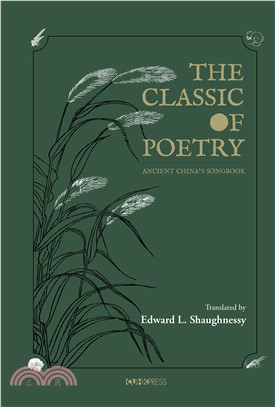
The Classic of Poetry (Shijing), also known as the “Mao Poetry” (Mao Shi), is the oldest existing collection of poetry in China, or indeed anywhere in the world. As a fountainhead of the Chinese literary tradition, it has endured over two and a half millennia of continuous readership. In this volume, eminent sinologist Edward L. Shaughnessy presents a complete English translation of the 305 discrete poems from the Classic of Poetry, divided into the Feng 風“ Ya 雅“ and Song 頌“ Combining the received text with newly unearthed manuscript discoveries, Shaughnessy offers a modern, authoritative interpretation that departs from the dated translations of earlier scholars. His masterful rendering encapsulates the essence of this poetic treasury, reflecting the diverse aspects of life, love, nature, and ritual in ancient China. -------------------------------------------------------------------------------------------------------------- Professor Shaughnessy’s translation of the Classic of Poetry provides us with a new and definitive rendition of this classic in world literature. For both specialists and general readers, this is certainly the definitive Classic of Poetry translation to have. — Joseph Allen, University of Minnesota, Twin Cities Solidly grounded in classical and modern scholarship, this book offers a thoughtful and highly readable English version of an archaic monument of world literature that in many of its lines appears once again as fresh and beautiful as it remains richly ambiguous and open to every new reader’s intuition. — —Martin Kern, Princeton University Professor Shaughnessy has translated the verses and prefaces of the Classic of Poetry into colloquial English that belies the philological labor subtending each line, with a preface that lays out the current state of manuscript variants. Here the classic appears in a less burdened form, regaining its directness and continuity. — —Haun Saussy, University of Chicago
作者簡介
Edward L. Shaughnessy is the Lorraine J. and Herrlee G. Creel Distinguished Service Professor in Early China Studies in the Department of East Asian Languages and Civilizations at the University of Chicago. Most recently the author of The Tsinghua University Warring States Manuscripts, Volume 2: The Shang Shu and Pseudo-Shang Shu Chapters (2024), Writing Early China (2023), A Brief History of Ancient China (2023), and The Origin and Early Development of the Zhou Changes (2022), he specializes in the textual heritage of ancient China, both the received literary tradition and also unearthed documents.
目次
Acknowledgments IX Introduction XI The Airs of the Countries 邦風 (1 160) / 1 The Tunes of Zhou 周南 (1 11) / 3 The Tunes of Shao 召南 (12 25) / 15 The Airs of Bei 邶風 (26 44) / 31 The Airs of Yong 鄘風 (45 54) / 53 The Airs of Wey 衛風 (55 64) / 65 The Royal Airs 王風 (65 74) / 79 The Airs of Zheng 鄭風 (75 95) / 91 The Airs of Qi 齊風 (96 106) / 115 The Airs of Wei 魏風 (107 113) / 127 The Airs of Tang 唐風 (114 125) / 135 The Airs of Qin 秦風 (126 135) / 149 The Airs of Chen 陳風 (136 145) / 163 The Airs of Kuai 檜風 (146 149) / 175 The Airs of Cao 曹風 (150––153) / 181 The Airs of Bin 豳風 (154––160) / 187 The Minor Odes 小雅 (161––234) / 199 The Major Odes 大雅 (235––265) / 319 The Hymns 頌 (266––305) / 393 The Hymns of Zhou 周頌 (266––296) / 395 The Hymns of Lu 魯頌 (297––300) / 427 The Hymns of Shang 商頌 (301––305) / 439 Appendix: Plants and Trees, Birds and Beasts Mentioned in the Classic of Poetry 447 Textual Notes 457 About the Translator 460